
Your website used to have one job: tell people who you are, what you do, and how to contact you.
That was enough when customers were willing to browse around, fill out a form, and wait for someone to get back to them.
But business has changed.
People want answers now. They want to know if you can solve their problem, what your services cost, whether you’re available, and what they should do next.
And if your business isn’t ready to respond?
Someone else probably is.
That’s where an AI website comes in.
But there’s an important distinction that gets lost in all the AI hype:
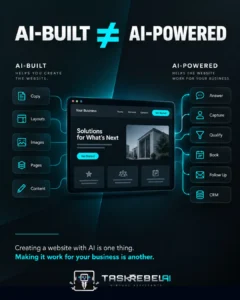
An AI-built website isn’t necessarily an AI-powered website.
AI can help you create a website faster. That’s useful.
But the bigger opportunity is building a website that can actually work for your business—answering questions, capturing leads, qualifying prospects, booking appointments, triggering follow-up, and helping your team stay on top of opportunities.
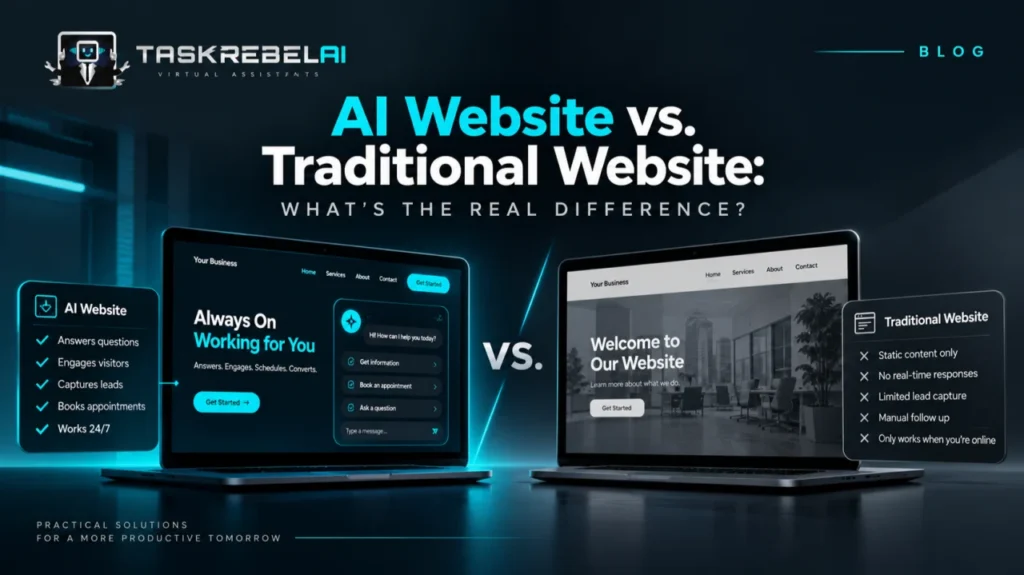
So, what’s the difference between an AI website and a traditional website?
Let’s break it down.
What Is a Traditional Website?
A traditional website is essentially your business’s digital storefront.
It gives visitors information about your company and provides ways for them to take action.
A typical traditional business website might include:
- A homepage
- About page
- Service pages
- Product pages
- Testimonials
- Blog
- Contact form
- Phone number
- Booking link
- Social media links
And there’s nothing wrong with that.
A good traditional website can build credibility, explain your services, showcase your work, and help potential customers find your business.
The problem is that most traditional websites are passive.
They wait for the visitor to figure out what to do next.
The customer arrives.
They browse.
They read.
They have a question.
They search for the answer.
They may fill out a form.
Then they wait.
And that’s where opportunities can start slipping through the cracks.
What Is an AI Website?
An AI website goes beyond simply displaying information.
It can use artificial intelligence to interact with visitors, answer questions, understand intent, capture information, qualify leads, personalize conversations, and trigger business actions.
In other words:
A traditional website gives people information.
An AI-powered website can help people take action.
Imagine a potential customer visits your website at 10:47 PM.
They’re interested in your service, but they have questions.
A traditional website might give them a contact form.
An AI-powered website can potentially start the conversation immediately.
It can answer questions, gather information, determine what the visitor needs, and guide them toward the next step.
That’s a completely different experience.
AI-Built Website vs. AI-Powered Website: They’re Not the Same Thing
This distinction matters.
An AI website builder uses AI to help create a website.
You provide a prompt, business information, industry, style preferences, or other details, and the AI helps generate pages, copy, layouts, images, or other website elements.
That’s useful.
It can dramatically speed up the process of getting a website online.
But once that website launches, it may still function like a traditional website.
It’s still essentially:
Visitor → Website → Information → Contact Form → Wait
An AI-powered website is different.
AI remains part of the customer experience and potentially the business workflow.
The journey can become:
Visitor → AI Conversation → Qualification → Action → CRM → Follow-Up
That’s the difference between using AI to build a website and building a website that uses AI to help run the business.
AI Website vs. Traditional Website: The Key Differences
Here’s the simplest way to look at it.
| Feature | Traditional Website | AI-Powered Website |
| Displays business information | Yes | Yes |
| Service information | Yes | Yes |
| Contact forms | Yes | Yes |
| Answers visitor questions | Usually static FAQs | AI-assisted conversations |
| Lead qualification | Mostly manual | Can be automated |
| Personalized conversations | Limited | Possible |
| Appointment booking | Often separate | Can be integrated |
| Automated follow-up | Usually separate | Can be connected |
| CRM integration | Possible | Can be deeply connected |
| 24/7 engagement | Limited | Yes |
| Workflow automation | Limited | Yes |
| Human handoff | Manual | Can be built into the workflow |
The important word here is can.
Not every website marketed as “AI-powered” actually provides all of these capabilities.
The technology behind the website matters.
So does how the system is configured.
That’s why the real question isn’t:
“Does my website have AI?”
The better question is:
“What can my website actually do for my business?”
The Biggest Difference: A Website That Waits vs. a Website That Responds
This is where things get interesting.
A traditional website essentially says:
“Here’s our information. Let us know if you have any questions.”
An AI-powered website can move toward:
“How can I help you?”
That shift may sound small.
For a business, it isn’t.
Think about someone searching for a local service late at night.
They land on your website and want to know:
- Do you provide this service?
- How much does it cost?
- Do you serve my area?
- How soon can someone help me?
- Can I schedule an appointment?
- What happens next?
On a traditional website, the visitor may need to find those answers themselves.
On an AI-powered website, the experience can become conversational.
The visitor asks a question.
The system responds.
The visitor provides information.
The system can determine what happens next.
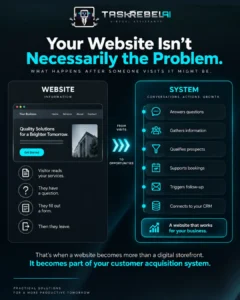
That’s not just a website anymore.
That’s part of your customer acquisition system.
What Can an AI Website Actually Do?
AI becomes valuable when it solves real business problems.
Here are some of the most practical ways an AI-powered website can help.
Answer Customer Questions
Customers don’t always want to search through five pages to find one answer.
An AI assistant can help visitors get information about things such as:
- Services
- Products
- Processes
- Hours
- Service areas
- Common questions
- Next steps
The goal isn’t to make your website sound futuristic.
The goal is simple:
Give people the information they need without making them work for it.
Capture More Leads
Someone visiting your website is already showing some level of interest.
The problem is that interest doesn’t always turn into a lead.
A traditional website may rely on a contact form that says:
Name. Email. Phone. Message. Submit.
An AI-powered experience can potentially make that interaction more conversational.
Instead of simply asking someone to fill out a form, the system can ask questions based on what the visitor is trying to accomplish.
That can provide your business with more useful information about the prospect.
Qualify Leads
Not every lead is equal.
Some people are ready to buy.
Some are researching.
Some aren’t a good fit.
And some just need more information.
AI can help sort those conversations based on the criteria that matter to your business.
That means your team doesn’t have to spend the same amount of time on every inquiry.
Instead, you can focus human attention where it matters most.
Less noise. More opportunity.
Book Appointments
Here’s another major difference.
A traditional website might tell visitors:
“Call us to schedule an appointment.”
Or:
“Click here to book.”
An AI-powered system can help guide the visitor through the process.
Depending on the setup, that can mean:
Question → Qualification → Availability → Booking
The fewer unnecessary steps between interest and action, the less opportunity there is for the prospect to disappear.
Follow Up Automatically
This is one of the biggest opportunities for small businesses.
A lead comes in.
Someone says they’ll call them back.
The day gets busy.
The follow-up gets forgotten.
The lead goes cold.
Sound familiar?
AI and automation can help eliminate that kind of operational gap.
Instead of relying entirely on memory, systems can be designed to trigger appropriate follow-up through channels such as email, SMS, or other communication workflows.
Because here’s the uncomfortable truth:
You don’t necessarily lose leads because people aren’t interested.
Sometimes you lose them because nobody followed up fast enough.
A Traditional Website Can Generate Leads. An AI System Can Help Work Those Leads.
This is an important distinction.
Your website isn’t necessarily the problem.
Your process after the website may be.
Imagine two businesses getting the same number of website inquiries.
Business A
A visitor submits a form.
The business owner receives an email.
They get busy.
They respond several hours later.
The customer has already contacted three competitors.
Business B
A visitor starts a conversation.
The system responds immediately.
The visitor provides information.
The lead is qualified.
The appropriate workflow begins.
The business owner or sales team gets the information they need.
The customer receives follow-up.
The difference isn’t necessarily the quality of the websites.
The difference is what happens after the visitor arrives.
That’s where AI-powered automation can become a serious competitive advantage.
Does an AI Website Replace Your Team?
No.
And that’s not how Task Rebel sees AI.
At Task Rebel, the philosophy is simple:
AI should work with you—not instead of you.
Your team brings things AI can’t replace:
- Judgment
- Relationships
- Experience
- Creativity
- Empathy
- Strategy
- Human connection
AI can handle repetitive work.
It can respond quickly.
It can organize information.
It can help qualify opportunities.
It can keep workflows moving.
That means your people can spend less time doing repetitive administrative work and more time doing the things that actually require a human.
That’s the idea behind AI Fusion:
Technology and talent working together.
What Does an AI Website Look Like in the Real World?
Let’s say you’re a local service business.
Someone searches for your service and lands on your website at 9:30 PM.
Here’s the traditional experience:
Google → Website → Browse Services → Contact Form → Wait
Now imagine an AI-powered experience:
Google → Website → AI Conversation → Questions Answered → Lead Qualified → Appointment Booked → CRM Updated → Follow-Up
That’s a completely different customer journey.
And it doesn’t have to stop at the website.
The website can become the front door to a larger business system.
That’s where the real power comes from.
The Real Value Isn’t the AI. It’s the Workflow.
AI by itself isn’t a business strategy.
Putting a chatbot on your website doesn’t automatically make your business more efficient.
The real value comes from connecting the pieces.
Think about this:
Website
↓
AI
↓
Lead Capture
↓
Qualification
↓
CRM
↓
Follow-Up
↓
Appointment
↓
Sales
↓
Customer Relationship
Now you’re not just talking about a website.
You’re talking about a system.
And that’s the direction businesses need to start thinking about.
Don’t add AI just because it’s trendy.
Use AI where it removes friction, saves time, improves responsiveness, and helps the business grow.
Is an AI Website Better Than a Traditional Website?
The honest answer?
It depends on what you need your website to do.
A traditional website may be perfectly adequate if your primary goal is to:
- Establish an online presence
- Explain your services
- Display your products
- Share company information
- Provide contact details
- Build credibility
There’s nothing wrong with that.
But an AI-powered website may be a better fit if your business needs to:
- Respond to leads faster
- Answer repetitive questions
- Capture leads 24/7
- Qualify prospects
- Book appointments
- Automate follow-up
- Connect website activity to a CRM
- Reduce repetitive administrative work
- Improve the customer experience
The question isn’t:
“Which website is more impressive?”
The question is:
“Which website helps my business operate better?”
AI Websites and SEO: Does AI Automatically Help You Rank?
Let’s kill another misconception.
Simply adding AI to your website does not automatically improve your Google rankings.
Search visibility still depends on fundamentals such as:
- Helpful content
- Search intent
- Clear website structure
- Relevant topics
- Strong user experience
- Technical SEO
- Original information
- Trust
- Expertise
- Mobile usability
- Proper internal linking
AI can support those efforts.
But AI isn’t a magic ranking button.
In fact, as search increasingly incorporates AI-generated answers and conversational experiences, businesses have even more reason to create content that clearly answers real questions and provides useful, original information.
Your website should be understandable to your customers and structured in a way that makes its information easy for modern search systems to interpret.
That’s where SEO, AEO, and conversational content strategies become increasingly important.
Your Website Has to Do More Than Look Good
A beautiful website is great.
But let’s ask a harder question:
What happens when someone actually needs something from your business?
Can they get an answer?
Can they start a conversation?
Can they become a lead?
Can they book?
Can your team see what happened?
Can someone follow up?
Can the system continue working after you close your laptop?
Because your website isn’t just a digital billboard.
It can be part of your sales and operations engine.
What Should You Look for in an AI Website?
If you’re considering adding AI to your website, don’t get distracted by flashy features.
Look at the business outcomes.
1. Can It Have Real Conversations?
An AI system should be able to understand natural questions and respond in a useful way.
2. Can It Capture Leads?
Make sure conversations can turn into usable customer information.
3. Can It Qualify Prospects?
Your system should help separate genuine opportunities from conversations that don’t require immediate human attention.
4. Can It Connect to Your CRM?
Your customer information shouldn’t live in five disconnected places.
5. Can It Trigger Follow-Up?
The conversation shouldn’t end when the visitor leaves your website.
6. Can It Book Appointments?
Make it easy for qualified prospects to take the next step.
7. Can a Human Take Over?
AI should know when the situation requires a person.
8. Can You Measure What’s Working?
You should be able to understand what happens to your leads and where opportunities are being won or lost.
9. Does It Actually Fit Your Business?
Generic AI isn’t enough.
Your AI should understand your business, services, processes, customers, and goals.
This Is Where Task Rebel Comes In
At Task Rebel, we don’t believe businesses need another disconnected tool.
You don’t need one platform for your website.
Another for your CRM.
Another for texting.
Another for email.
Another for appointment booking.
Another for automation.
Another for tracking leads.
Another for follow-up.
And then another spreadsheet to keep track of all of it.
That’s not a system. That’s spaghetti.
Task Rebel is built around a different idea:
One System. Less Chaos. More Growth.
Task Rebel combines business automation, CRM functionality, funnels, messaging, lead management, follow-up, and AI-powered workflows into one connected system.
That means your website doesn’t have to operate in isolation.
It can become part of the larger machine.
Your AI can help respond.
Your CRM can organize.
Your automations can follow up.
Your funnels can convert.
Your team can focus on the opportunities that need a human.
That’s the Rebel way.
Stop Chasing Leads. Build a System That Chases Them for You.
Most business owners don’t need more things to do.
They need fewer things falling through the cracks.
They need:
Faster responses.
Better follow-up.
Cleaner processes.
More visibility.
Fewer repetitive tasks.
More qualified opportunities.
More time to actually run the business.
That’s what makes an AI-powered website interesting.
Not the word “AI.”
Not the latest chatbot.
Not another shiny technology trend.
The real opportunity is building a business where technology handles the repetitive work while your team focuses on growth and relationships.
AI Website vs. Traditional Website: The Bottom Line
A traditional website is primarily a place where customers can find information about your business.
An AI-powered website can become a place where customers interact with your business.
That’s the real difference.
A traditional website says:
“Here’s what we do.”
An AI-powered website can say:
“Tell me what you need, and let’s figure out the next step.”
And when that experience is connected to your CRM, automation, follow-up, booking, and sales process, your website becomes more than an online brochure.
It becomes part of your business infrastructure.
You don’t need AI just to say you have AI.
You need a system that helps your business respond faster, follow up consistently, and grow without adding more chaos.
That’s the point.
Don’t just build a website. Build a system that works.
Ready to Build an AI Website That Actually Works for Your Business?
Your website shouldn’t sit there waiting for customers to figure everything out.
It should help answer questions.
Capture opportunities.
Start conversations.
Move prospects forward.
And keep working when you aren’t.
That’s what Task Rebel is built to help you do.
Build My AI Website →
Stop hustling. Start automating.
Build a business system that works while you work—and keeps working when you don’t.
Frequently Asked Questions About AI Websites
What is an AI website?
An AI website is a website that uses artificial intelligence to interact with visitors, answer questions, capture information, personalize conversations, qualify leads, or automate business actions. Unlike a purely traditional website, an AI-powered website can participate in the customer journey instead of simply displaying information.
What is the difference between an AI website and a traditional website?
A traditional website primarily provides information and relies on visitors to take the next step. An AI-powered website can interact with visitors, answer questions, qualify leads, support bookings, and connect website activity with business automation.
Is an AI website the same as an AI website builder?
No. An AI website builder uses artificial intelligence to help create a website. An AI-powered website uses AI as part of the website’s ongoing functionality after it launches. A website can be created with AI and still operate like a traditional website.
Can an AI website generate leads?
Yes. Depending on how it is configured, an AI-powered website can engage visitors, ask qualifying questions, capture contact information, and move prospects toward an appropriate next step.
Can an AI website book appointments?
Yes. AI-powered website systems can be connected to calendars and booking workflows so qualified visitors can schedule appointments without waiting for someone from the business to respond manually.
Can an AI website replace a salesperson?
AI can automate repetitive parts of the sales process, but it shouldn’t automatically replace human relationships. The strongest approach is often AI handling repetitive interactions and qualification while humans handle complex conversations, relationships, and decisions.
Does an AI website improve SEO automatically?
No. Adding AI to a website does not guarantee better rankings. SEO still depends on helpful content, search intent, technical quality, website structure, user experience, credibility, and other established search fundamentals.
Should my small business have an AI website?
If your business receives leads, answers repetitive questions, books appointments, or spends significant time on follow-up, an AI-powered website may be worth considering. The best solution depends on your business model, customer journey, and existing workflows.
What makes Task Rebel different?
Task Rebel isn’t focused on adding AI for the sake of having AI. The goal is to connect AI with CRM, lead management, automation, funnels, messaging, follow-up, and other business workflows so technology can help reduce chaos and keep opportunities moving.
The Rebel Takeaway
Your website shouldn’t just be online.
It should be working.
While you’re serving customers, it’s working.
While you’re closing deals, it’s working.
While you’re sleeping, it’s working.
And when a new opportunity shows up, you shouldn’t have to hope someone remembers to follow up.
That’s the difference between having a website and building a system.